
Multi-Station Rotational Stop AGV Trolley: The Core Pillar of Intelligent Handling Driven by Magnetic Strip Navigation
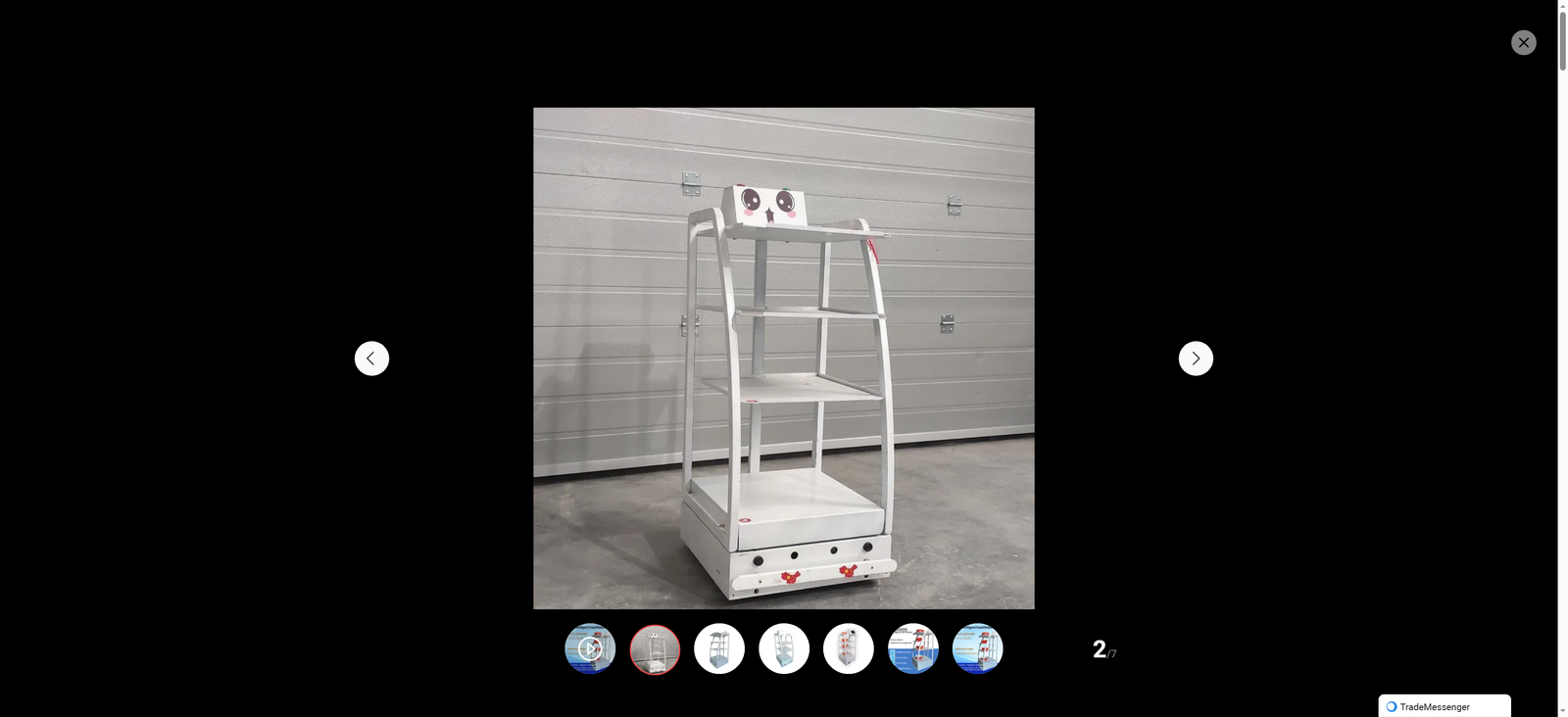
In the wave of global intelligent manufacturing transformation, automated handling equipment has become a key link in breaking through the bottlenecks of traditional logistics. Among them, the Multi-Station Rotational Stop AGV Trolley, with magnetic strip navigation as its core and multi-functional integration as its advantage, is gradually penetrating into various industrial scenarios, redefining the efficiency and safety standards of unmanned handling. This intelligent equipment not only solves the pain points of low efficiency, high cost and potential safety hazards in manual handling but also provides a flexible and reliable solution for the integration of production and logistics, becoming an important driving force for industrial upgrading.
Magnetic Strip Navigation: The Stable Core of Multi-Station Precision Operation
As the "navigation brain" of the multi-station rotational stop AGV trolley, magnetic strip navigation technology lays a solid foundation for its high-precision and stable operation. The core principle of this technology lies in laying magnetic strips with specific magnetic properties on the predetermined path. The AGV trolley is equipped with high-sensitivity magnetic navigation sensors that can real-time detect the magnetic field signal of the magnetic strip, convert the magnetic field strength into electrical signals, and transmit them to the control system to determine the relative position between the trolley and the magnetic strip. With the assistance of RFID sensor tags, the trolley can accurately identify functional nodes such as crossroads, turning points and stations, and complete actions such as path correction, rotational stop and task switching autonomously.
Compared with other navigation technologies such as laser SLAM and visual navigation, magnetic strip navigation has unique advantages in multi-station application scenarios. Firstly, it has strong environmental adaptability, and is not affected by changes in ambient light, ground pollution or complex spatial structures, ensuring stable operation even in harsh industrial environments such as workshops with dust and oil stains . Secondly, the positioning accuracy is outstanding. The high-precision magnetic sensor can achieve positioning accuracy of ±10mm and walking accuracy of ±10mm, which fully meets the requirements of multi-station rotational stop for precise docking . In addition, the magnetic strip navigation system has the characteristics of simple structure, low single-machine cost and fast deployment. The standardized overall control program can realize rapid project landing, and the entire system can be put into operation in a short time from installation and debugging to formal production . Although it has the limitation of fixed path, it is highly compatible with scenarios with fixed process routes and frequent multi-station operations, such as assembly lines and warehouse sorting areas.
Multi-Station Rotational Stop: Breaking the Limitation of Single-Station Handling
The multi-station rotational stop function is the key feature that distinguishes this AGV trolley from traditional handling equipment, and it is also the core support for realizing efficient circulation of materials. Different from the single-point transportation mode of traditional AGVs, this type of trolley can preset multiple stop stations in the system according to production needs, and complete actions such as automatic docking, loading and unloading, and material transfer at each station through rotational stop. The realization of this function relies on the precise coordination of the magnetic strip navigation system and the control system: when the AGV trolley detects the RFID tag at the preset station, the control system will issue a stop command, and the differential drive unit will drive the trolley to rotate and position to ensure that the material transfer mechanism is accurately aligned with the station interface .
In practical applications, the multi-station rotational stop function shows significant value in optimizing the logistics process. Taking the auto parts manufacturing industry as an example, in the transfer process of bumper from injection molding to painting, the AGV trolley can realize multi-station circulation operations such as picking up materials at the injection molding station, temporary storage at the inventory station, and feeding at the painting station . It not only reduces the waiting time between processes but also ensures the "first in, first out" principle of materials through time stamp binding, effectively reducing the defective rate caused by manual transfer . In the 3C electronics manufacturing industry, the trolley can complete the transportation of precision components between multiple assembly stations, with anti-static coating and flexible gripper configuration to avoid component damage during handling . The flexible rotational stop design enables a single AGV to undertake the handling tasks of multiple stations, reducing the number of equipment configurations and saving the workshop space by 30% compared with traditional handling modes .
Multi-Functional Integration: Building an Intelligent Handling Ecosystem
As a multi-functional intelligent unmanned handling robot, the multi-station rotational stop AGV trolley is not limited to simple material transportation, but realizes the integration of multiple functions through modular design, meeting the diverse needs of different scenarios. The core of its multi-functional expansion lies in the replaceable upper module and open control interface: according to the actual operation requirements, modules such as robotic arms, lifting platforms, roller transfer mechanisms and anti-static devices can be configured to realize the integrated operation of "handling sorting stacking loading and unloading" .
In terms of safety performance, the trolley is equipped with multiple protection mechanisms to ensure safe operation in human-machine coexistence environments. Laser obstacle avoidance sensors with adjustable 3-meter protection range and safety edges can realize 360° environmental perception, and the collision rate is close to zero . At the same time, it supports two stop modes: slow stop and emergency stop, which can quickly respond to abnormal situations and avoid safety accidents. In terms of system integration, the AGV trolley can seamlessly connect with MES (Manufacturing Execution System) and WMS (Warehouse Management System), realize the automatic issuance of production tasks, real-time scheduling of trolleys and dynamic monitoring of the whole process . The visualization path editing function and wireless screen communication allow operators to modify parameters and adjust tasks conveniently, and the standardized underlying motion control interface supports secondary development to meet the personalized needs of enterprises .
Industry Application and Development Trend: Embracing the Era of Intelligent Logistics
Driven by the dual engines of manufacturing upgrading and logistics efficiency improvement, the multi-station rotational stop AGV trolley has been widely applied in automobile manufacturing, 3C electronics, food processing, logistics warehousing and other fields . In the automobile industry, it undertakes the transfer of parts between assembly lines, reducing the number of manual handlers by 6 people per double shift and significantly improving production efficiency . In the logistics warehousing field, it cooperates with automated three-dimensional warehouses to complete the in-out warehouse operation of goods, improving the storage turnover rate by more than 40% . In the food processing industry, the compact body design can adapt to narrow aisles with a width of only 1.2 meters, realizing efficient handling of raw materials and finished products .
Looking forward to the future, with the deep integration of 5G, AI and digital twin technologies, the multi-station rotational stop AGV trolley will show a more intelligent development trend . On the one hand, the combination of magnetic strip navigation and multi-modal navigation technology will make up for the limitation of fixed paths, realizing flexible switching between fixed routes and dynamic paths . On the other hand, the popularization of hydrogen fuel and solid-state battery technology will solve the problem of short battery life, further improving the continuous operation capacity of the trolley . At the same time, the cluster scheduling technology of AGV will be more mature, realizing the collaborative operation of multiple trolleys and forming an intelligent handling network covering the whole workshop . As an important part of the intelligent factory, the multi-station rotational stop AGV trolley will continue to play a core role in reducing costs and increasing efficiency for enterprises, and promote the industry to move towards a new stage of "unmanned" and "flexible" production .
In conclusion, the multi-station rotational stop AGV trolley, with magnetic strip navigation as the core and multi-functional integration as the advantage, has become an indispensable key equipment in the process of industrial intelligent transformation. Its stable operation performance, efficient multi-station handling capacity and flexible functional expansion provide a strong guarantee for enterprises to optimize the logistics process and improve production efficiency. With the continuous iteration of technology and the expansion of application scenarios, this intelligent unmanned handling robot will surely release greater value in the global intelligent manufacturing wave.