
Guiding Service Robot: Revolutionizing Customer Experience Across Hotel, Restaurant, Airport and Exhibition Hall
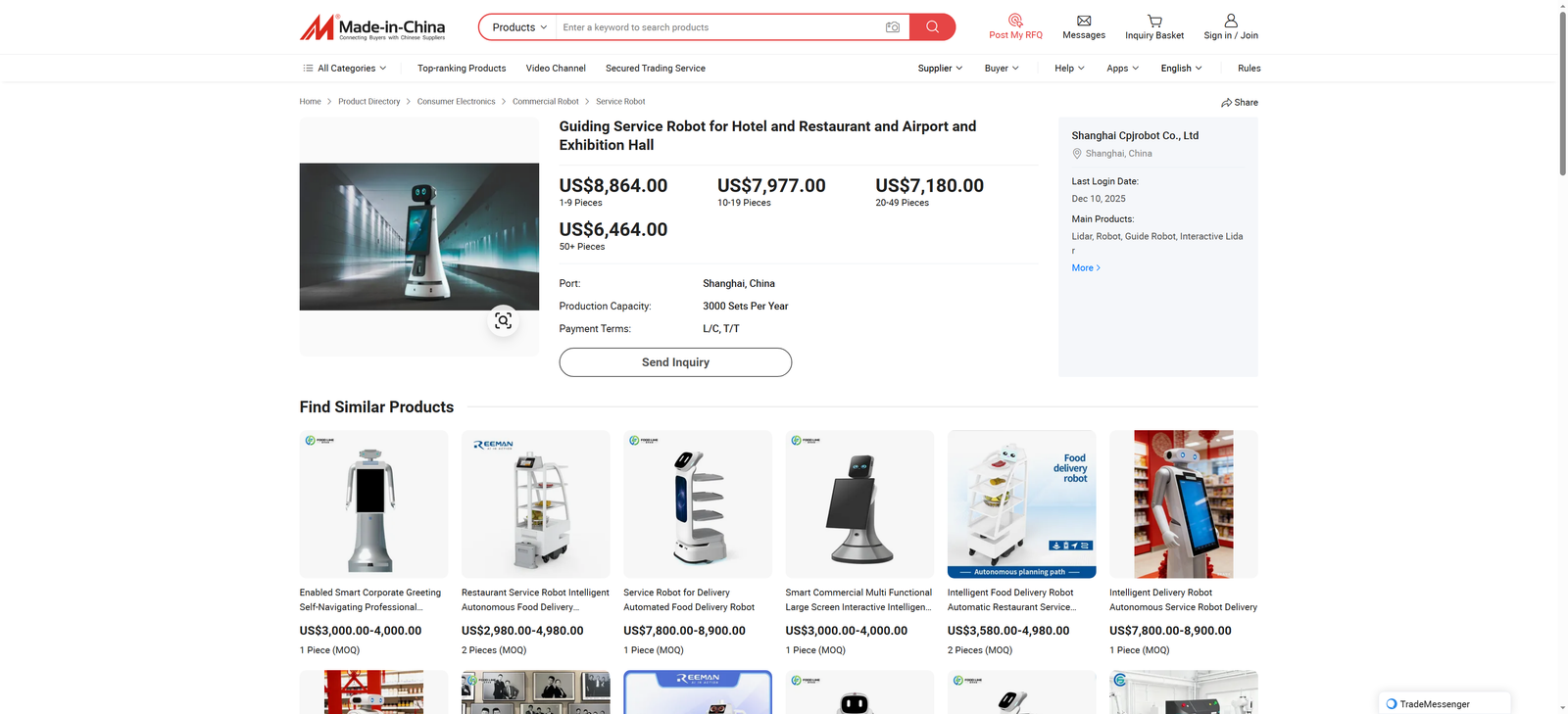
In the era of digital transformation, intelligent service robots have gradually become an indispensable part of public service scenarios, bringing unprecedented changes to customer service and on-site management. Among them, guiding service robots, with their high efficiency, accuracy and humanized interaction capabilities, have been widely applied in four core scenarios—hotel, restaurant, airport and exhibition hall. They are no longer just "high-tech decorations" but practical assistants that optimize service processes, reduce labor costs and enhance customer satisfaction, injecting new vitality into the traditional service industry.
Hotel: Elevating Hospitality with Intelligent Guidance
Hotels, as window industries of hospitality services, pursue refined and efficient service experiences to leave a deep impression on guests. Guiding service robots perfectly meet this demand by undertaking a series of guiding and auxiliary tasks that were previously completed by human staff. Upon guests’ arrival at the hotel lobby, the robot can quickly identify guests through face recognition technology, greet them warmly in multiple languages, and provide real-time guidance to check-in counters, elevators, restaurants, conference rooms, gyms and other areas. Unlike human staff who may be busy or distracted, the robot maintains consistent service quality 24 hours a day, avoiding errors caused by fatigue or negligence.
In addition, the guiding service robot in hotels can also provide value-added services such as luggage assistance (coordinating with luggage handling robots), room number confirmation, hotel facility introduction, and even local tourist information recommendation. For business hotels with frequent conference activities, the robot can guide participants to the designated conference room accurately according to the meeting schedule, and remind them of the meeting time in advance. This not only reduces the workload of front desk and concierge staff but also enables guests to enjoy a more convenient and seamless hospitality experience, helping hotels establish a high-end and intelligent brand image.
2. Restaurant: Streamlining Dining Processes with Smart Assistance
The catering industry has always faced pain points such as long waiting times, chaotic seating arrangements and heavy workloads for waiters during peak hours. Guiding service robots have effectively solved these problems, becoming a new "artifact" for restaurants to improve service efficiency. When customers enter the restaurant, the robot can quickly inquire about their party size, check the real-time seating status, and guide them to the appropriate table without any delay—eliminating the need for customers to wait for a waiter to lead the way and reducing the possibility of seating conflicts.
Moreover, the guiding robot can also assist in simplifying the dining process: it can send electronic menus to customers’ mobile phones, guide them to scan codes to order and pay, and even remind the kitchen of special requirements (such as "less spicy" or "no garlic") to ensure the accuracy of orders. For large-scale catering venues such as buffets or wedding banquets, the robot can guide customers to different food areas, introduce dish types and ingredients, and help the elderly, children and other groups with mobility difficulties to get food conveniently. By undertaking guiding, ordering and auxiliary services, the robot frees up waiters to focus on food quality and intimate service, improving customer dining satisfaction and the restaurant’s turnover efficiency.
3. Airport: Optimizing Travel Experience with Efficient Navigation
Airports are large-scale public transportation hubs with complex layouts, numerous functional areas (such as check-in, security check, boarding gates, baggage claim, and transfer areas) and a huge flow of passengers. For passengers who are not familiar with the airport layout, finding the correct route quickly has always been a major difficulty. Guiding service robots have become a reliable navigation assistant for airport passengers, solving the problem of "getting lost at the airport" fundamentally.
Equipped with high-precision positioning systems and 3D map navigation, the airport guiding robot can accurately plan the shortest route according to the passenger’s needs—whether it is guiding to a check-in counter of a specific airline, a security check channel, a boarding gate, or a transfer counter, baggage claim area, airport lounge, or even a restroom or restaurant. Passengers only need to input their flight number, destination or target area through voice or touch screen, and the robot will lead the way in real time, broadcast route prompts, and avoid crowded areas automatically. In addition, the robot can also provide real-time flight information inquiries (such as flight delays, gate changes), remind passengers of boarding times, and introduce airport services (such as luggage storage, currency exchange, and duty-free shopping). For international passengers, the robot supports multi-language interaction, breaking the language barrier and making their travel more smooth and convenient. By reducing the workload of airport staff and improving navigation efficiency, the robot helps airports alleviate passenger congestion and optimize the overall travel experience.
4. Exhibition Hall: Enhancing Visiting Experience with Professional Guidance
Exhibition halls host various exhibitions (such as industry exhibitions, product fairs, and cultural exhibitions) all year round, with diverse exhibition areas, rich exhibition contents and a large number of visitors. For exhibitors, how to attract visitors and introduce products effectively; for visitors, how to find the exhibition areas they are interested in quickly and understand the exhibition contents in depth—these are the core needs of both parties. Guiding service robots play a key role in connecting exhibitors and visitors, enhancing the professionality and interactivity of the exhibition.
For visitors, the exhibition hall guiding robot can provide personalized visiting guidance: according to the visitor’s interests and needs, recommend relevant exhibition areas, plan a reasonable visiting route, and introduce the background, characteristics and details of the exhibits in detail through voice, pictures and videos. Visitors can interact with the robot by asking questions, and the robot will answer them accurately based on the pre-input exhibition information, solving the problem of insufficient professional explanation staff. For exhibitors, the robot can help attract visitors’ attention through intelligent interaction, introduce products and services to potential customers automatically, collect visitor information (with permission), and provide data support for exhibitors to analyze the effect of the exhibition. In addition, the robot can also guide visitors to rest areas, toilets, catering areas and other supporting facilities, and remind them of the exhibition opening and closing times, ensuring a comfortable and efficient visiting experience.
Future Outlook: Towards More Intelligent and Humanized Service
From hotels and restaurants to airports and exhibition halls, guiding service robots have shown unique advantages in optimizing service processes, reducing labor costs and enhancing customer experience. With the continuous development of artificial intelligence, big data, and Internet of Things technology, guiding service robots will become more intelligent and humanized in the future: they will have stronger voice recognition and natural language processing capabilities, be able to understand complex user needs and interact with humans more smoothly; they will be equipped with more advanced sensing technologies, be able to adapt to complex environments (such as crowded areas, uneven ground) and provide more flexible services; they will also realize data interconnection with the management systems of various scenarios, helping managers grasp service status and user needs in real time and make scientific management decisions.
In conclusion, guiding service robots are not replacing human staff, but complementing and upgrading human services. In hotels, restaurants, airports, exhibition halls and other scenarios, they are building a more efficient, convenient, and intimate service system, promoting the transformation and upgrading of the traditional service industry. With the continuous innovation of technology, guiding service robots will surely play a more important role in the future, bringing better service experiences to people’s life, work and travel.